
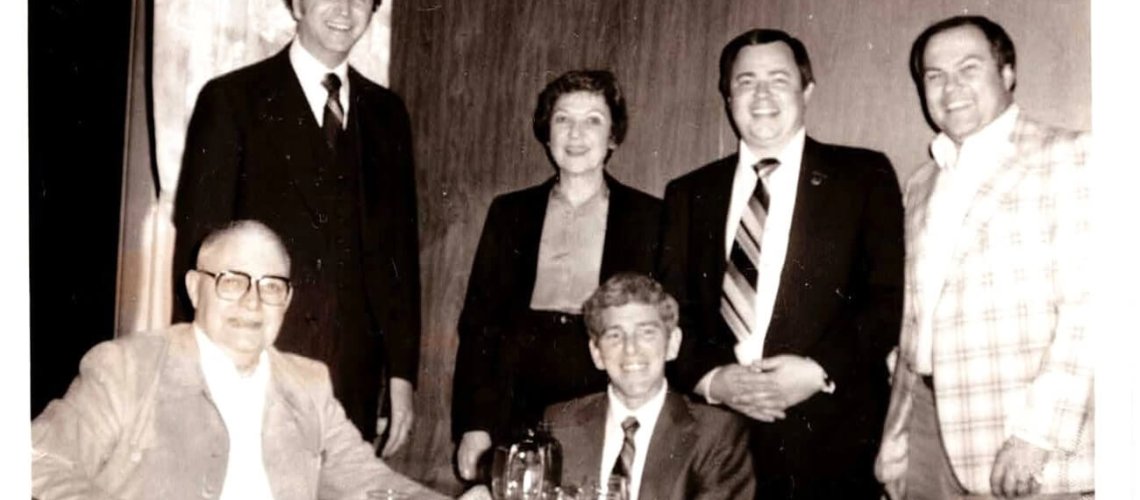


Dan Lago, Mike Hipp, and Pat Washmon
August 12, 2026 (6th draft)
Introduction
Mike Hipp responded to a recent posting about a 1976 Mountain Man knife on a Facebook group “Queen City and Schatt & Morgan Knives” with definitive facts about a 1976 Queen Mountain Man. He agreed to be interviewed and helped me connect with Pat Washmon who owned the Washmon Sales Group (manufacturers’ representatives agency) they both worked at for many years, Pat for 18 years and Mike for 38 years. Both men have reviewed and corrected this oral history. We thank them for a very enjoyable conversation and being willing to share this history about how Queen reached its customers in key southern states.
For those who want some detail on Queen’s early sales approach, before the cutlery was sold to Servotronics, please see David Krauss’ book American Pocketknives: A History of Schatt & Morgan, and Queen Cutlery (2002, p. 135).
How Queen Knives were Sold
Mike was working an early job as manager of a restaurant as a 20-year-old, when he was approached by his second cousin to serve as a Manufacturers Rep for the Washmon Company. He was asked what he was making and was told by the owner of the company, Dean Washmon, that “We can’t afford you” who then immediately hung up! The Washmon family had owned Hudson car dealerships in Hartington and McCowan, Texas, but faced failure during the Great Depression (They didn’t get around to asking for money at the time of sale, or for payments afterwards, because nobody had any money, Pat recalls). As the economy grew after WWII, Dean Washmon started an agency that represented various manufacturers to local stores in Texas, Arkansas, Louisiana, and Oklahoma (a huge four-state territory known as TALO.) He eventually retired as a very successful millionaire and Pat continued to run the business.
Later, as the company grew, Pat hired Mike Hipp and they became responsible for representing Queen across those four states. Dean Washmon had carried a Queen pocketknife and strongly urged Pat to get that contract because they were a very well-made knife. In fact, Pat still has that Queen knife his father carried. That contract took a while because Queen was very loyal to its representatives, but eventually, a Queen Rep did pass, and Washmon Company was able to pick up two states. They did well and as Queen shifted away from its older factory-based sales agents, they got all four states.
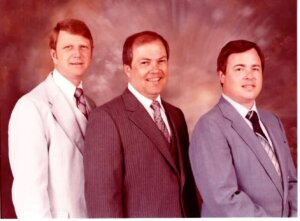
Washmon Sales Group, 1978-9. Pat Washman (Center), Mike Hipp (right), and Bill Coursey (left). Mr. Coursey is not one of our respondents. (photo ©Mike Hipp collection, 2026)
Washmon Group finally got the Queen contract and held it for years. Prior to getting the Queen contract The Washmon agency carried a brand called Olsen knives. They were okay but not all that special and we never looked back after we got the Queen contract. They worked with Queen’s sales manager, Robert “Bob” Siple, who insisted they come up to visit the Titusville, PA, cutlery to see where the knives were made. Mike recalls that trip was very helpful to see those benches with all the dimples and dents on them to see how long knives had been made by hand in that old building.
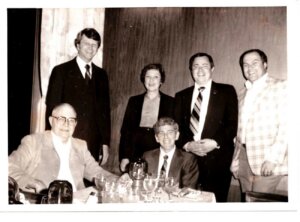
Front Row: Dean Washmon, (left) seated with Robert (Bob) Siple (right). Second row: (left to right) Bill Coursey, Patsy Washmon (Deans wife and Pat’s Mother) Mike Hipp, and Pat Washmon, during the trip to the 1980 SHOT show. (photo © Mike Hipp collection, 2026)
A little history can be seen in the business cards (below). The agent Washmon Sales replaced was Jay Frank Jordan, who was a factory salesman and carried a Queen card. During Bob Siple’s tenure, Queen shifted to Manufacturers Representation to improve their sales.
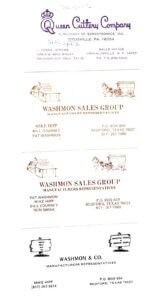
Washmon Sales was based in Bedford, Texas, and as they grew, they shifted to individual cards. (photo © Mike Hipp collection, 2026)
The Process
The Washmon firm traveled to a variety of stores, hardware stores, Western Auto, western wear stores, fishing and hunting stores, small department stores and always looking to broaden their coverage of the huge area they were responsible for. They developed contracts with each store owner or manager to carry Queen knives or the other items they also carried. They also represented other manufacturers, including Buck Knives, Thompson Center, Sheridan pellet guns, Bianchi holsters, and others.
This was not “selling” as a factory-employed salesman. When they visited a store, they could offer a variety of merchandise to the owner, depending on what merchant felt they needed and what they would sell in their specific area. Pat recalls, “We would open our catalogs and allow them to be the hero picking what they thought would sell. They were in charge and we would offer suggestions.” Both men felt their work was all about building trust: In our business, we realized the great differences in our various market regions and so we never pushed a single product – we were there to help them, both Mike and Pat stressed. In Louisiana, it was almost like learning a different language in the creole areas. Along the coast, shrimpers and fishermen had specific needs, oil riggers, ranchers, farmers, and so on.
Both Mike and Pat emphasized that they had to develop a trusting relationship with each store owner, listen to what they needed, and provide good advice and products they could readily sell at a good price. Offer products their customers really liked. If you crossed someone, you could never get back in their door, so trust was essential with each owner. “We thrived on repeat business – We were not “selling” for a company, we were supporting their business.”
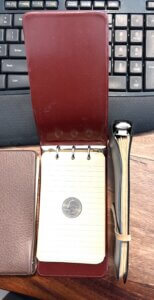
Both Mike and Pat each used “Account Notebooks,” (photo © Mike Hipp collection, 2026)
The account notebooks were a perfect size for carrying in a shirt or pants pocket or sport coat, and available locally from a Woolworths Store and were very “mobile”. All the accounts for one week were lined up from START (point A) to STOP (point B). As one worked through the book, the rubber band was changed from “done” to “needs to be done.” The quarter gives a sense of scale for this essential tool. Only, at the end, did they start to use order form or computer systems.
Over the weekends, you would set up your next trips, and prepare the postcard for mailing, letting the dealer or distributor know that we would be arriving at their location the following week. Each postcard was complete with arrival information on them, a list (or logo of all the factories we represented. Our postcards stimulated the buyer to focus on what they needed to order. This was a proven method to increase sales and reduce time spent with each buyer. “Time is money”; Good for us and our customers. Then, every Monday you would take off to cover a different area. Go as far as you could, stopping at each place to add inventory or develop new contracts.
Knife Sales
Pat recalls that Shrade was a very popular knife throughout their region, and it competed a bit better than Case, but since neither brands were ones they carried, we didn’t try to shift them away from what they wanted to sell. Both those companies both made a lot of very attractive knives. We didn’t worry about it.” Among their brands, Pat recalls ‘Buck knives was the leader in sales across our entire territory.”
Both Pat and Mike felt that closer to the coasts of Texas and Louisiana, Queen had a very big market. Especially the big chief, with the large stainless blade that held an edge, the aluminum handle, and a very economical price! They were able to offer big chiefs wholesale at between $1.50-to $1.90 for years (DJL – the Big Chief was originally offered at $.99 a piece in 1953, so still a great value in the 1970s through the ‘90s!). They were able to sell that knife in huge quantities, sometimes a gross of knives at a time. Mike recalls orders of 3 gross at a time – imagine 432 Big Chiefs in a single order! Queen packed and sold their paper-wrapped knives, 6 in each box; That was the practice for so many of the older knife makers – not the fancy unique boxes for each knife.
Queen’s other knives with the simple Delrin handle, also sold well because the Queen stainless steel had a very good reputation – a less expensive knife that was a great value as a tool. Most of their stores carried a relatively few Queen knives, four or five patterns that they knew their local market would want and that varied by the region. Mike recalls, “Certainly, in Texas among the ranchers, we sold a lot of knives with spey blades; There were a lot of Rocky Mountain oysters that needed to be processed in those days!” The toothpicks (#20) and slim trappers (#11 and #24) were also carried by many stores.
Both men were consistent in recalling that they did not sell many Queen fixed blade knives. Mike recalls, “Probably for every 100 pocketknives, we might sell one fixed blade knife. Our guys would just pull out their pocketknife, (like a Queen #39), butcher the deer, and then put it right back in their pocket – “that deer will never care what knife you used to skin it.”
Mike felt that Queen Stainless steel was very good for us. Many guys would buy a pocketknife with carbon steel blade and set it out under their porch to “cure” so it got a patina that would protect it a bit. But stainless steel was very much preferred, and guys were willing to pay a bit more for it.”
Relationship with Queen
Mike recalls that Bob Siple, Queen’s sale manager, was great to work with. He listened when we told him what would sell. And he got Queen to produce them. A great example was the Big Chief (model #45) in a “diver” version. Many guys, especially shrimpers and oil riggers wore gloves and were always losing a hold on their knives. Shrimpers would often set their knife down on the gunnel of the boat or raft and into the water it would go. We suggested the “diver” version to Siple and Queen, with easy open and a bale for a lanyard so you could keep track of it, and that was a great seller for us.
Pat also remembers, “We also pushed Siple for more lockback knives because we knew that Buck was selling a lot of them, and Bob did end up with all those Rawhide and Minuteman knives in different sizes and a good value because of those stabilized wood handles and the blade etches that still highlighted the 440 stainless steel. We could sell them in Queen’s markets, but still not as much as the Buck knives – they were very popular and our bestsellers. Pat recalls that Queen was committed to the stabilized wood and the “Rawhides” were simply not as pretty as the bucks and therefore didn’t sell as well. Pat recalls “We suggested changes they should have made, but they were not listening to us as well during the ‘80s. (DJL – this also might represent the time when Queen began to focus on production of collector knives with Blue Grass Cutlery, {the John Primble and Winchester brands}, to cope with a major economic downturn for the company.)
Mike indicated that “Bob Siple was sharp too, because some people were taking advantage of the ‘sample program’ – They could buy knives at 50% of the wholesale prices. But he noticed that they were buying more knives at the sample price than they were selling in their orders. So, he stopped that sample program. He made Queen steel known very well all through the south.”
Travel issues
Later, when we got bigger, Mike and Pat would leave their car at an airport, fly back home, fly back at the beginning of the next week, and then start again next Monday. They also tried to plan “circle routes” so at the end of a week you were back close to home. Pat sometimes got an apartment (cheaper than using hotels) in a part of his territory and stay there while swinging through his large territory. Over time, they decided to divide their territories. Mike had Lousiana, Oklahoma and east Texas; Pat had Dallas, Fort Worth, and Houston and that helped them to be much more efficient.
Both men agreed, ‘We believed in the travel – “Out of sight, Out of Mind.” It was a very personal kind of work. Whether they ordered through us, or contacted the factory directly, we got commissions from every knife that was sold if we had a contract with them, even if we hadn’t done it in person.
The time between face-to-face visits varied over the year. Both Mike and Pat targeted a three-month window between face-to-face visits. You had to prepare the order, give time for the factory to prepare the order, mail it back to the owner, who needed some time to sell the new inventory, before a return visit would result in new business. In the latter part of his years, Mike recalled, “We would stratify customers into levels of volume of sales, and for the higher volume customers we might increase our face-to-face visits as quick as 10 weeks.”
Still, the business required a lot of travel. Pat indicated “I would buy a new car every 2 years, usually a big, comfortable Chrysler Newport, put 50,000 miles on it every year, and then turn it over to his wife, and get a new reliable car for his work. We had to keep our vehicles in top shape, always take care of them.”
Changes in the Business
About 1991, their business had to change as manufacturers modernized away from smaller, “local” agencies. Washmon lost several major contracts with manufacturers, not because his team was unproductive, just corporate policy changes. Pat shifted away to other pursuits, but Mike continued with another Manufacturer Representative agency that also carried Queen Cutlery. Pat recalls that Mike was “very well-liked and very capable. He was great for us, so it made sense he would continue in that line of work.”
Mike remembered how it changed. “In my earlier days, it was common to stop every 30 or so miles from one store to the next. By the time we finished, bigger box stores had begun to take over. Gibsons, Walmarts, etc.; They were pretty much taking the personal, local product decisions away. We had to drive 3 -4 hours between each store we serviced. Some of those little towns we used to visit no longer even existed.
Collector Knives
Mike pointed out that we knew Queen was starting to produce more fancy knives, like the Drake Well Barlow (1972) with the nice sawcut bone. (He couldn’t help himself, but exclaimed, “They must have made a ton of those!”) “Or the Mother of pearl knives – they were quite nice. A few times, Bob Siple helped me get some of those nice knives with a rare serial number – #000.” “We didn’t get too excited about Winterbottom bone or fancier knives, generally; our buyers preferred the Delrin. For us it was the stainless steel at a good price that would keep an edge. That is what sold.”
Mike very much liked the knives he was able to provide. “Sometimes we might buy back several of the fancy knives when we made visits. They would let us look through their inventory. If we saw a nice knife that was not selling for them, we would offer to buy it back at a price that cut their losses and encourage them at the same time to upgrade their stock with newer ones that they could sell better. A win for both of us. We knew what they had paid, so we could get a bargain using our own money and we could sell their ‘new old stock’ for a good price sometime in the future. You do get to know knives when you handle them every day.” I bought a number of smoked pearls for $5.00 each, since they were a very small knife. Eventually, years later, since no one in my family wanted them, I sold them to A. G. Russell.
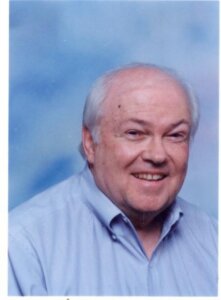
Pat Washmon, about 2015, (photo © Mike Hipp collection, 2026)
Conclusion
Both Mike and Pat thought that they liked Selling Queen Knives and getting to know a lot of customers! It was a good living, paid very well if you were good at it, and suited both of them very well even if it might not have been right for someone else. “Do what you love and you will never work a day in your life”, was Mike’s assessment. I would add that both men were a joy to talk with and gave us considerable insight in how Queen managed selling their knives in a very important area of the country. My thanks to Mike Hipp and Pat Washmon!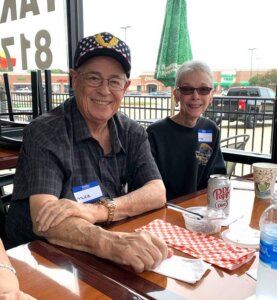
Mike Hipp and his wife Lynne, enjoying a vacation trip in 2023. Enjoying life in retirement after decades as a Queen Manufacturers Representative (photo © Mike Hipp collection, 2026).
REFERENCE
David (2002). American Pocketknives: A History of Schatt & Morgan, and Queen Cutlery. Krauss Publications, 3260 Euclid Heights Blvd., Cleveland Heights, Ohio 44118.